 Kerdili
Kerdili
means: hand it over… I'll pay you later.
The word said every day across the counter, turned into an app: the same credit notebook you know — but this time in the shopkeeper's pocket AND the customer's. Same lines, same total, in front of both.
Two books, two memories, one number.
Every credit sale gets written down twice — once in the shop's karny, once in the customer's head. Nobody compares the two until the day of counting, and by then there is nothing left that can tell you which one is right.
- ✗The sum comes out wrong. Thirty lines added up by hand, between customers, with someone waiting at the counter. One digit carried wrong and the total stays wrong for the rest of the month.
- ✗The page goes missing. A karny is a working object. It gets wet, it gets torn, a page comes loose — and everything written on it leaves with it.
- ✗The whole book disappears. Left somewhere, ruined, or simply not found again. Every debt in it now rests on what two people can agree they remember.
- ✗“Why is it this high?!” The total is read out at the counter and it sounds bigger than it should be. There is nothing to check it against, so the number itself becomes the argument.
- ✗Nobody remembers six weeks. Bread on Monday, oil on Thursday, something for the children on the way home. The small lines are most of the total, and they are the first ones to go.
- ✗Zero visibility. Unless you keep your own notebook too, you only find out what you owe by standing at the counter and asking. So each side records alone — and then they have to sit down together and count. Time wasted, energy wasted.
The day both books come out.
This is what settling up looks like now. The shop reads down its page. The customer goes through what they can remember. Put the two columns side by side and see where they land.
- 2/9 Flour, oil, sugar
- 5/9 Milk, bread never came up
- 9/9 Semolina 25kg shop says
- 14/9 Coffee, tea, tomato paste This amount cannot be read — the page is damaged. page torn
- 21/9 Detergent, soap
- 26/9 Sent his son — biscuits never came up
- 2/9 Flour, oil, sugar
- 9/9 Semolina 25kg he says
- 21/9 Detergent, soap
- and nothing else that he can bring to mind
- 2/9 Flour, oil, sugar
- 5/9 Milk, bread
- 9/9 Semolina 25kg
- 14/9 Coffee, tea, tomato paste
- 21/9 Detergent, soap
- 26/9 Sent his son — biscuits
With Kerdili there is only one column, and both sides have been reading it since the first line was written. Nothing to compare, nothing to remember, nothing to argue about.
Two columns, filled in separately. Compare them to see the gap.
Two honest people, apart. What happens next is an argument nobody can win.
One column. Both sides have been reading it all month.
Try the app as it really works — step by step.
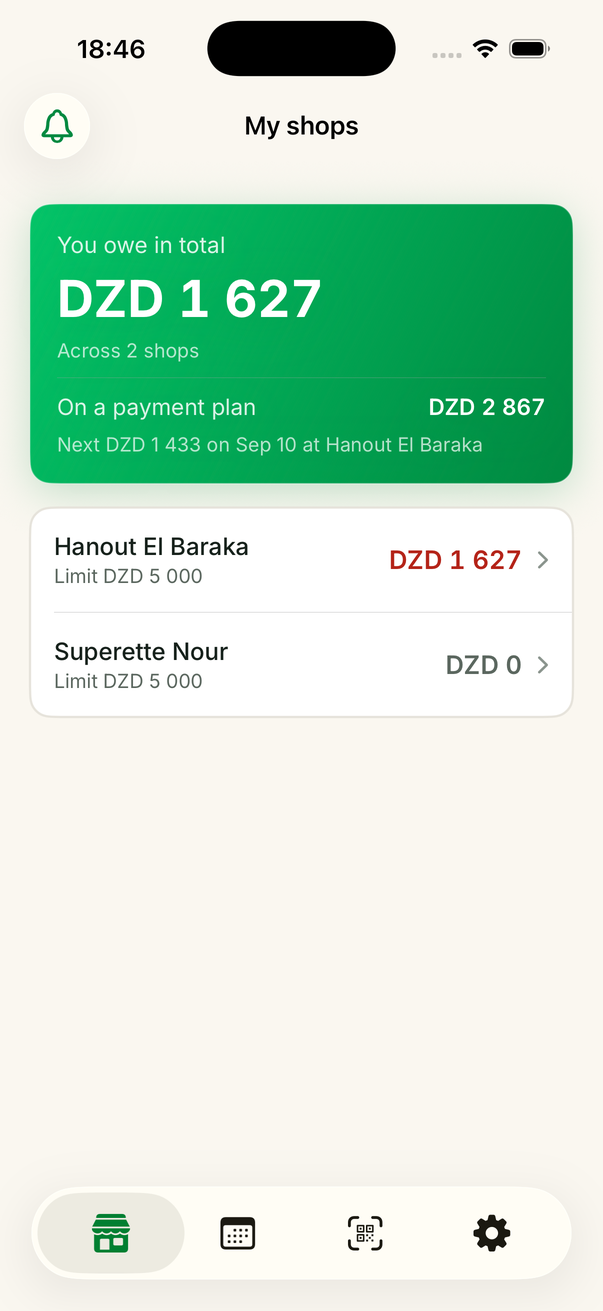
These are real screens, straight from the app. Pick a step and watch the same sale move from the shop's basket to a receipt that carries its own code.
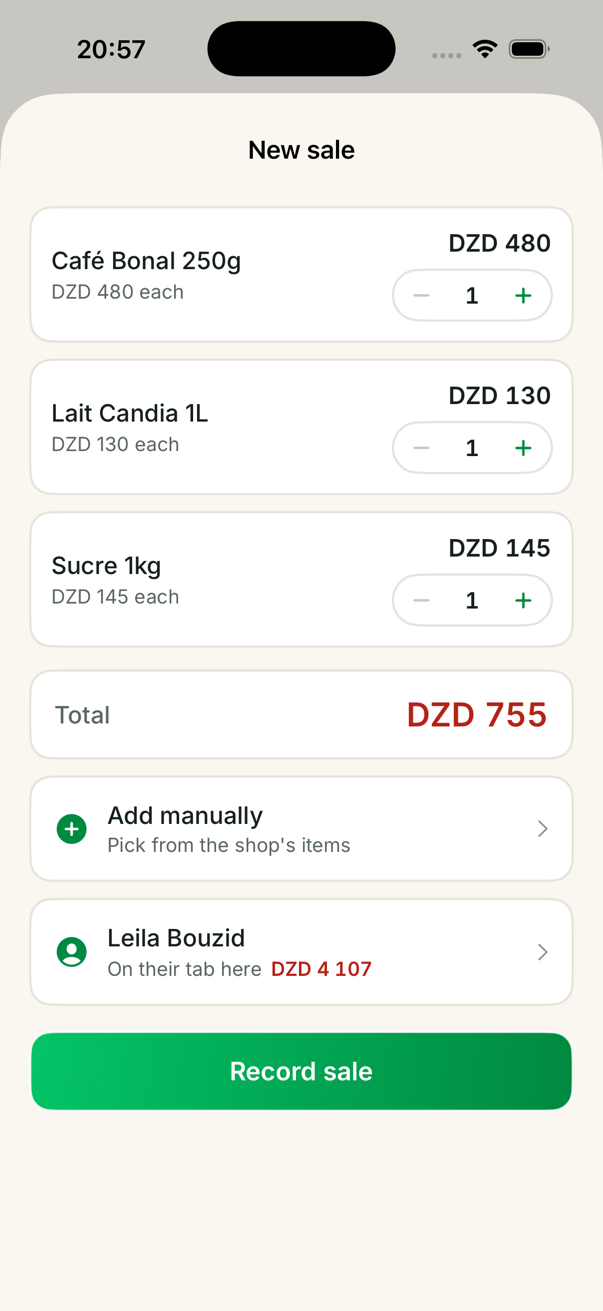
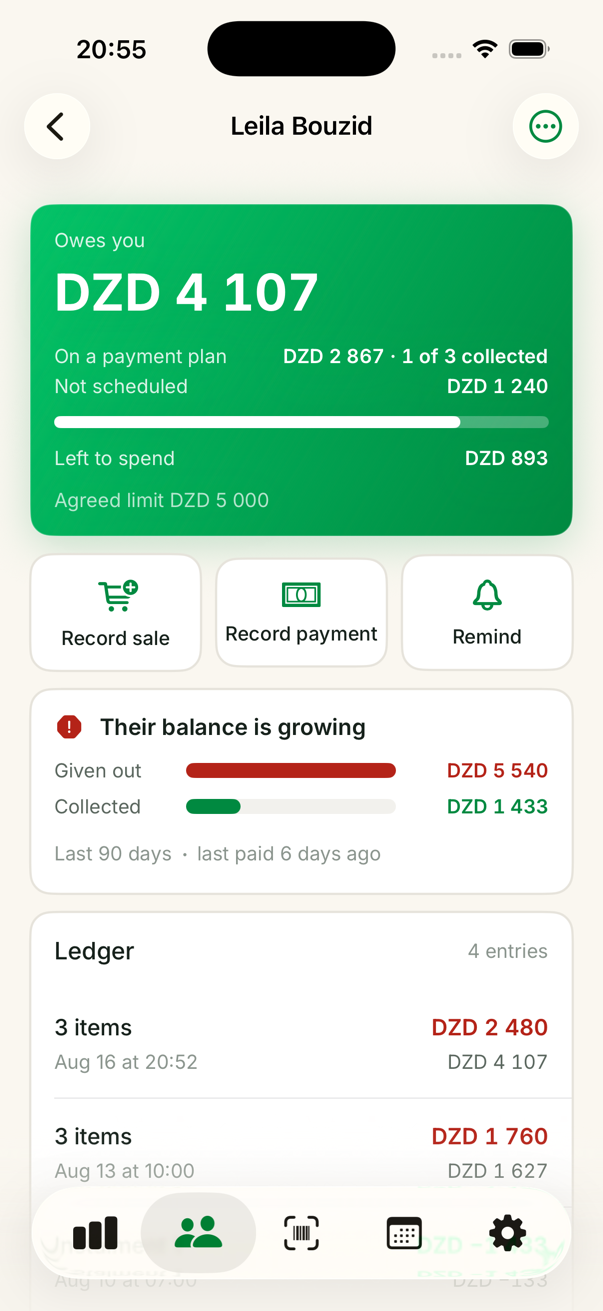
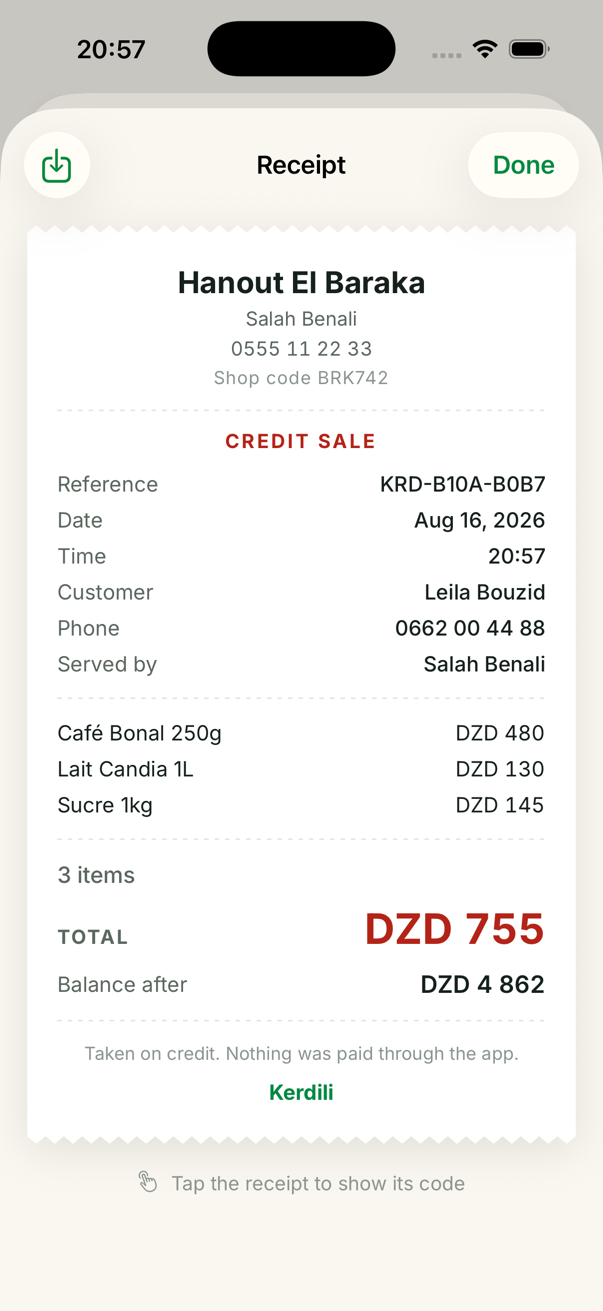
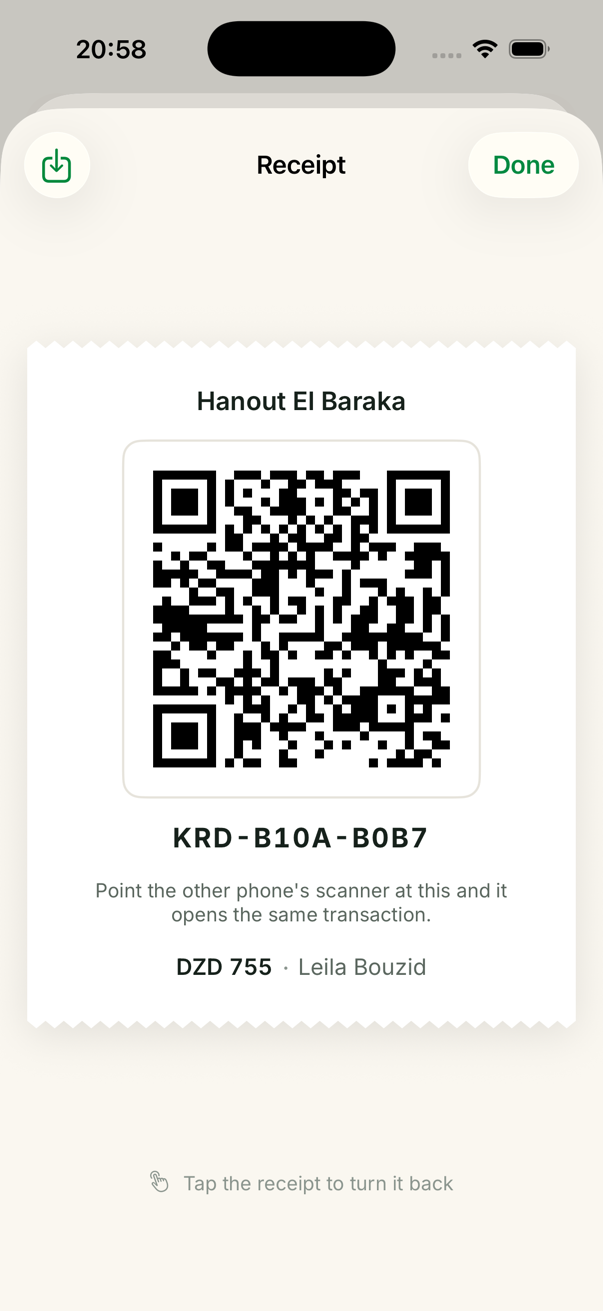
Real screens · nothing here is a mock-up
Not a sketch. The real thing.
taped to the wall, like the price list!
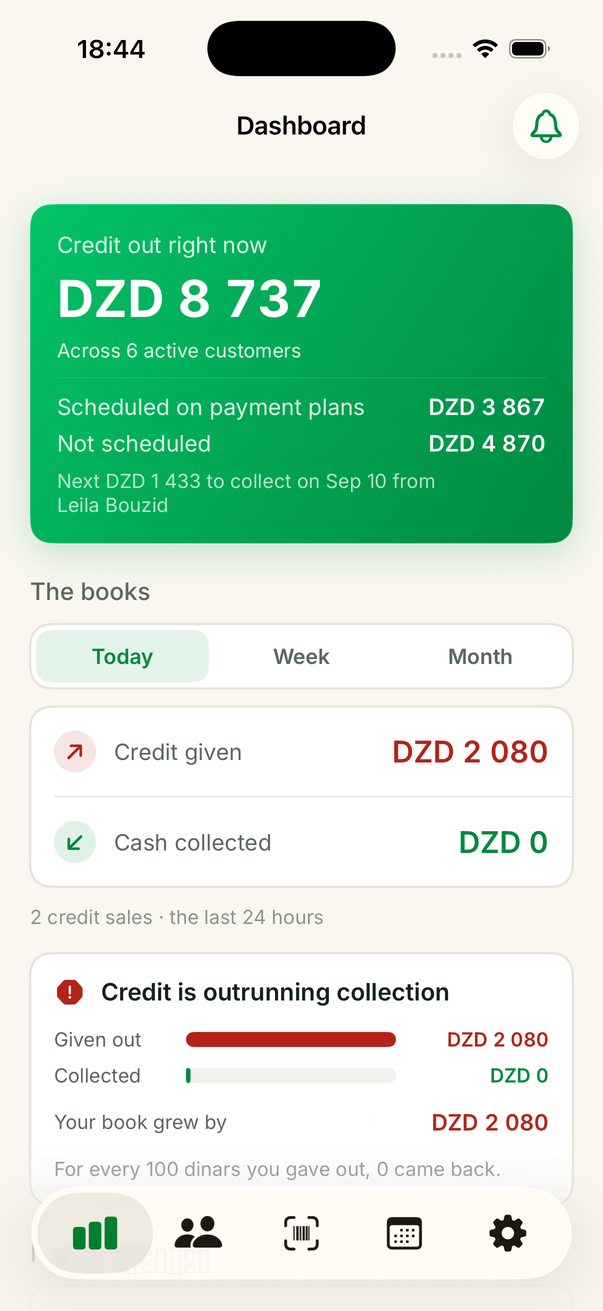
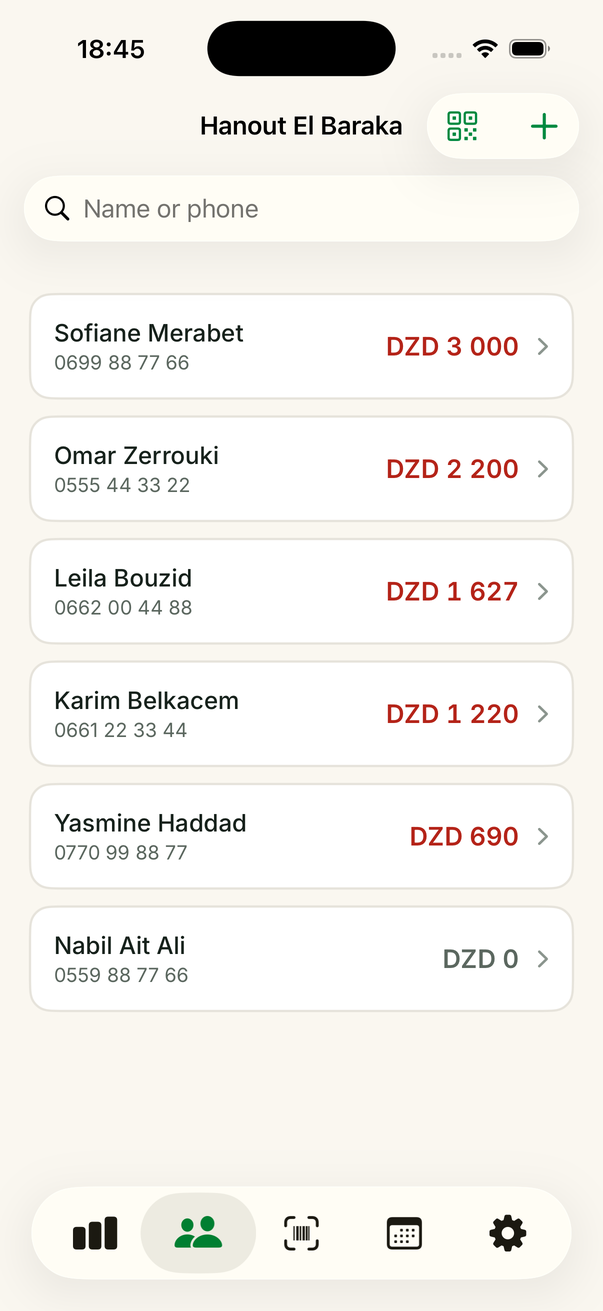
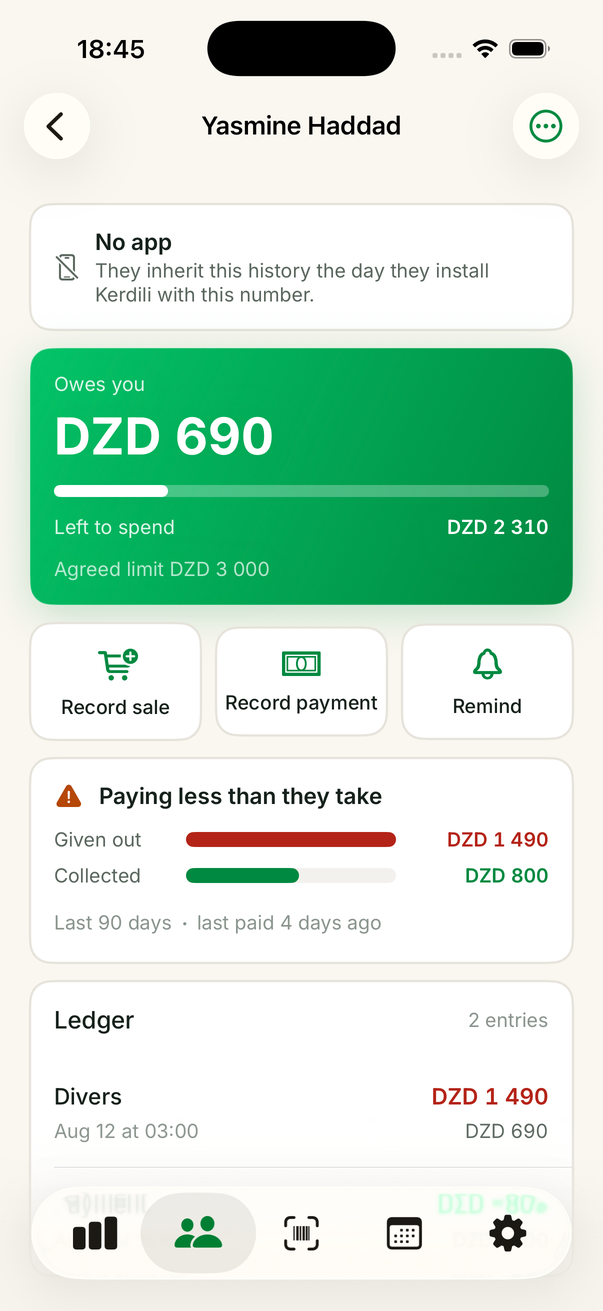
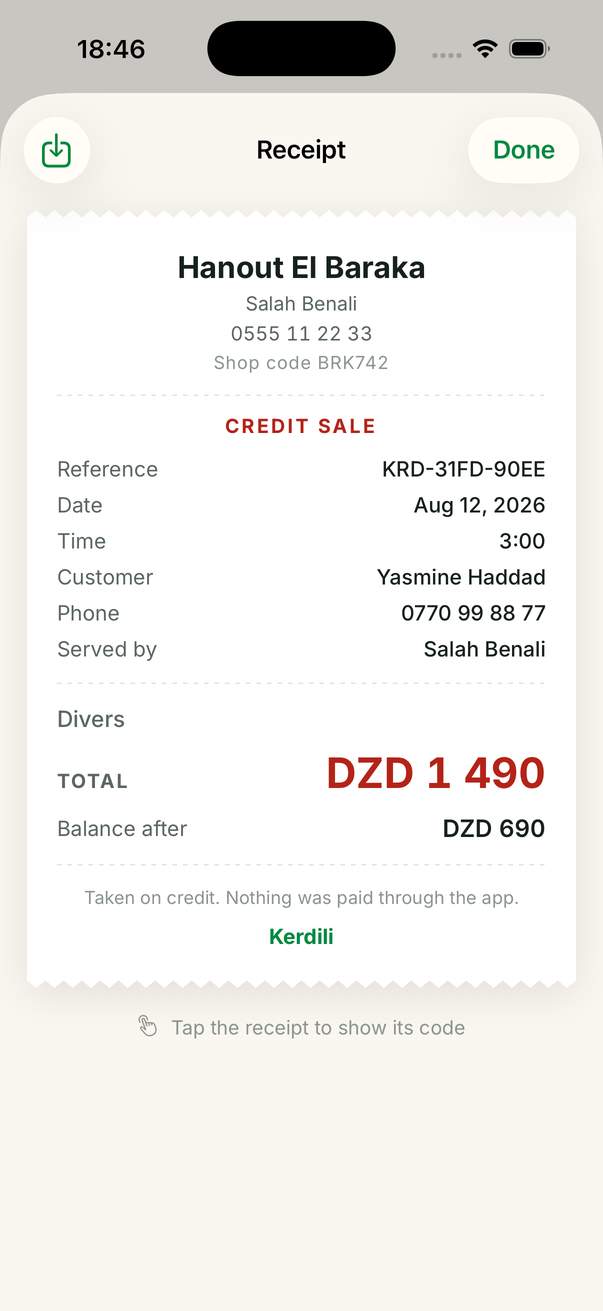
Tap any receipt in the app and it flips over to a QR code — the other phone scans it and lands on exactly that transaction.
Record faster. Collect faster.
without changing your habits!
A dashboard that counts for you
Credit out, cash collected, what's on a schedule and what has no date — and who has stopped paying.
A till in your pocket
Scan barcodes into a basket, or keep your own product list with prices and photos. Two taps and it's on the tab.
Staff who can't see the books
A worker set to “records only” gets the till and nothing else. Every line still names who wrote it.
Payment plans
Split a balance into instalments. Approve, counter, or refuse — and mark each one collected when the cash arrives.
Receipts & PDF statements
Every line becomes a real receipt with a reference number. Save it as a PDF, print it, or send it on WhatsApp.
Customer has no app? Fine
Add them with a name and number, start today. When they install Kerdili, their whole history is waiting.
Add the customer
Name and phone number — one minute, no app needed on their side.
Record credit as usual
From day one, like any other customer: sale by sale, payment by payment.
The day they install it
They verify their number and find their whole karny waiting.
The notebook is not free either.
Nobody hands you a bill for the karny. You still pay for it — in money, in time, and in the evenings you spend proving a number.
You buy it, and buy it again
A notebook is money off the counter, and a shop that gives credit fills them far faster than it expects to.
You add it up by hand
Line by line, between customers, at the end of every month. That hour belongs to your shop, not to arithmetic.
Then you count it a second time
Once for you, once when the customer disagrees. The recount costs more than the paper ever did — and it costs it in temper.
Kerdili is 600 DZD a month, and the adding is already done — for you and for them, at the same moment.
600 DZD / monthYour receipt. Your balance. Your say.
no more “how much do I owe?”
Receipts within a second
Every time the shopkeeper writes a line, you get a notification with the details and the new balance.
Your balance, always
Don't wait for the end of the month to find out — the total and what's left of your limit are clear at any moment.
Split the balance
Balance grew? Propose instalments with clear dates; the shopkeeper approves or counters. Edit or withdraw it while it's pending.
The whole family, one book
A son or a wife gets a QR code, not a login. The shop scans it — their name goes on the line, the debt stays on your account.
All your shops in one place
The hanout, the greengrocer, the grocer — each with its own karny, all in one app.
Your secret stays yours
Your credit is between you and your shop alone — no other store can ever see it. Not a total, not a hint.
Three things we will never do.
We never erase.
Every line is written once and stays. Mistakes are fixed with a new line, in front of both sides — never by quietly deleting.
We never sell.
Your credit is between you and your shop. No store sees another store's karny, and nobody buys the data.
We never touch money.
Kerdili only writes things down — it never sends, holds, or processes money. Paying stays as it always was: hand to hand, at the shop.
What shopkeepers ask us.
What if my customer has no smartphone? +
That's the normal case, not the exception. You add them with a name and a number and write credit against them straight away. The day they install Kerdili and sign in with that number, the whole history becomes theirs.
Can another shop see what someone owes me? +
No. Every screen in the app is built from your own relationships only — there is no way in Kerdili to see a customer's balance across shops.
What if I write the wrong amount? +
You add a correction. It sits in the ledger next to the original and both stay visible to both sides. Nothing is ever edited or deleted, which is what makes the book worth trusting.
Does the app take a cut of the money? +
No money passes through Kerdili at all. Cash is handed over at your counter exactly as it always was; the app is the paper, not the till.
Can my worker use it without seeing the books? +
Yes. A worker set to “records only” gets the till and the product list — no balances, no ledger, no plans, no dashboard. Every entry still records who wrote it.
Does it work in Arabic? +
Yes, fully, and you switch language inside the app. Dates keep Latin months the way they're read in Algeria, and amounts stay in Western digits with DZD.
next up: your hanout?
Looking for pilot shops.
Kerdili is in development. If you run a hanout and want to try it with your customers — or you're a customer who wants to suggest it to your shopkeeper — talk to us.
Support team on WhatsApp: +213 550 26 23 52
Kerdili records credit only — it never sends, holds, or processes money.